Showing posts with label exeter college. Show all posts

Monday, September 6, 2010

capstone [monday] - mentoring incoming mbas

This year, the Saïd Business School is introducing a "mentoring" scheme to incoming MBAs. I registered my interest, and indicated that I was willing to help up to five MBAs. I thought that other (prospective) students might also find this advice useful, so I've posted it below:

Welcome to Oxford! Congratulations on getting accepted into the MBA program. I'm your MBA mentor. I just arrived in Oxford this morning, as our concluding 'Capstone' course began today, and ends with graduation on Saturday.

This past year was one of the best experiences of my life! As a member of Exeter College, I was 32 y/o when I started the program. It was actually my second time here, as I studied abroad at Oxford during my junior year at SUNY Stony Brook. I'm also engaged to be married this October, but my fiancée stayed in New York to work while I completed my MBA. I would say that half of the MBAs bring their spouses, and the other half do not.

Before coming to Oxford I worked as a FINRA Registered Principal (Series 7, 24) at Citigroup Smith Barney, where as a financial advisor, I constructed investment portfolios for retail clients. I had also owned my own coffee shop in New Jersey, and spent several years during college managing my brother's chain of cafes in the Hamptons.

I also serve on the Board for the Microfinance Club of New York, and teach financial literacy to high school students. We have a very diverse MBA class, but I think that in general, you will find that all the MBAs accepted have the following characteristics: entrepreneurial background (or ambitions), leadership, and volunteer work.

Homework assignment:

Yes, in addition to Tomo Suzuki's Financial Accounting assignment, I'm giving you some additional homework. Many incoming MBAs have already found my blog on the web: http://justinbelkin.blogspot.com. I've also linked to Andrew Bergbaum's blog (06'-'07), which I think is terrific. For either blog, I suggest starting your reading in August, and work your way forward, so that you'll get the most applicable information to your current situation first. For example, you'll learn about getting a bank-account and cell phone in my 'pre-MBA' and 'Michaelmas' term blog entries, whereas issues such as electives and the Strategic Consulting Project, only become relevant during later terms.

In conclusion, welcome to Oxford. Enjoy your time here, because it will go fast. This email was 'heavy' on biography, because this way you'll know how I fit into your life, and how I might be of better help to you. I encourage you to email me questions at: justinbelkin@hotmail.com.

I'll leave you with some good parting advice that I received when I started my MBA:


(1) Essentially, you'll never need to leave SBS. You'll probably live nearby, plus SBS serves three meals daily, and they have a library, and showers! Knowing this, trust me...make an effort EARLY ON to get involved with your College by: playing sports, attending bops, and dining "in-hall."

(2) What's the purpose of an MBA? Yes, it's true that you're here to learn new skills, to learn how to work under pressure, etc. I think that more importantly, however, is that you're here to network with a group of bright and ambitious classmates. At the Turf tavern, there's a sign that commemorates how an Australian Prime Minister, Bob Hawke (and former Oxford student), drank 2 1/2 pints of beer in 11 seconds. Go out and have fun; you never know what position you and your classmates may one day rise to.

PS: On that note, out of 238 MBAs in 2009-10, I hold the record for having invited 120 MBAs to dinner at Exeter College at a cost of £5 per person. One of my friends was close behind me with 80 invitations. Dining 2nd Hall in College is the least expensive and most sumptuous 3-course meal served in the most idyllic setting. If dinner is too expensive, then invite your friends on the weekend to brunch in College for about £2 each. Mmmm...delicious full English breakfast. Take advantage of this subsidy, and make some new friends, too.

(3) Business school is a good lesson for life. No one will just give you what your heart desires, rather you have to go out and get what you want. Career Services will not offer you a job. No one will make sure that you squeeze every experience out of Oxford as possible. This is all up to you. So, come to Oxford with a plan.

(4) You can only do two out of three things well: grades, social life, sports. No one has accomplished all three. For example, the students who made Dean's List were also voted as having spent the most time in the library. There is indeed a correlation. But if you're spending all the time in the library, then you're also not waking up at 5am to go rowing. And if you're rowing that early, then you're probably not partying until 1am at Fuzzy Ducks in Cowley either. You can begin to see the tradeoffs, right? Make your choice, and be comfortable with it.

(5) Let's face it, many people choose Oxford because of the great "sweatshirt equity" (name brand). Few schools, in fact, are more famous and well known than the elite top four universities in the world (in chronological order): Oxford, Cambridge, Harvard, and Yale. Congratulations for having been accepted to at least one of these schools. It is now your responsibility to represent Oxford well. Start a blog, run for student politics/OBN/SIG, and dress/speak professionally when recruiters come visiting. PS: I'm involved with the New York OBA chapter, and I'll be helping running the table at the September NYC MBA World Tour. Do the same in your country.

(6) Yes, £36,000 for tuition and college fees is a lot of money. There are two ways of looking at this. Some take the short-term perspective: they attend 17 classes a year that meet 3 hours per week for 8 weeks, which means that 408 hours are spent in class. When divided by total tuition, you are paying approximately £88 per an hour of instruction. So, why would anyone miss a class!? On the other hand, someone with a long-time horizon might say: they plan to live until age 90, and are currently 30 y/o, therefore they have 60 years to go. When multiplied by 365 days a year you discover that you have 21,900 left to live; pretty morbid. This calculation means that you pay about £1.64 per day for the rest of your day for the right to call yourself an Oxford graduate whether you attend class, or skip class to attend Wimbledon, or the Royal Ascot horse race. That's less than a cup of coffee at Starbucks each day; just think of the silly things we spend money on. Regardless of your approach and time-horizon, make the most of your time here.

Tuesday, September 8, 2009

pre-mba: freshers' pack (and bank account)

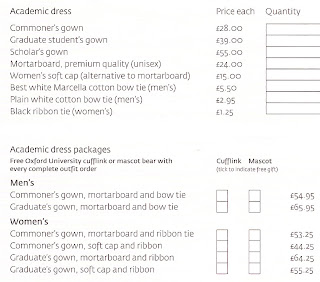
With less than a month to go before classes start, I was getting nervous that I hadn't heard much of anything from either the B-school or Exeter College. My nerves were partially relieved when I received a "Freshers' Pack" from Exeter College. This package, which is sent to all new incoming students (by their respective College), took about ten days to travel from Oxford to New York. It listed an itinerary of mandatory, as well as optional events, that I would attend once I arrive in Oxford. Unfortunately, the first optional event designed to introduce students to their new college, called the "Postgraduate Induction Session," is being held on September 30th, which conflicts with my mandatory B-school orientation. Nevertheless Exeter made up for this by offering to meet their incoming Freshers at the Gloucester Green Bus Station (if requested), which I thought was very nice of them. Exeter is also hosting their "Graduate Freshers' Dinner" on October 6th where the dress code is "Formal & Gown" as new students dine at the High Table by candlelight! Lucky for me the packet also contained an advertisement from "Ede & Ravenscroft" on where to buy such Oxford garb and at what price.


The Freshers' Pack also contained two copies of my housing contract ("Graduate Tenancy Agreement"), which is VERY important when you want to prove your UK address to the immigration officer when you first fly into Heathrow. By and large, the university does not send you an inordinate amount of paperwork, so it's natural to sometimes feel a little worried when you haven't heard from them in a while - especially because they're overseas, making visiting them or calling them difficult. As I poured over the Exeter materials I also read through the red-colored "Handbook for Students" that provides you with useful things, such as a staff directory, and when meals are served in Hall. I was also terribly relieved to find a "Letter of Introduction to UK Banking Facilities," signed by Exeter's Academic Secretary. The one thing I read over and over again in other peoples' blogs is that you want to have your bank account, and cell phone account, set-up as soon as possible. Otherwise you'll fall behind in class while trying to go through this frustrating process. *Important note* One needs a bank account BEFORE they can get a cell phone.

The four main UK banks in Oxford include Barclays, HSBC, Lloyds, and Natwest. An excellent chart comparing the banks is available here. I favor Barclays and HSBC, because I think they are more international, having several locations in New York. That being said, you can only open the account in person in Oxford. I believe that HSBC, however, allows you to start the account opening process online, but you must still visit a branch in person to finalize the account.

As an international student you will also find yourself limited to the type of account that you can open. For example, when attempting to sign-up for a Barclays Student Account I was told that I only qualified for their iBank Student Account, because I was a "non-permanent UK resident" defined as "a person who has lived in the UK at least three years before starting higher education studies." Essentially this means we're stuck paying higher fees. The HSBS Passport Student Account charges £84 per year with a one year firm commitment. The Barclays iBank Student Account charges £60 per year. You can print a short application from the Barclay website and pre-fill it out before returning it to the Oxford bank branch located on Cornmarket Street. I'm sure that there exists other banks in Oxford that charge no fees, however, the bank may not be as large or international as the ones I have mentioned.

Other than that, my Freshers' Pack contained some forms that I need to return upon arriving in Oxford. For example, I need to return my Graduate Tenancy Agreement, Graduate Freshers' Dinner reservation, Exeter College Student Contract, Exeter College Graduate Freshers' Information Sheet, and some doctors forms. Most of the paperwork only needs to be signed and reviewed so I'm not sweating it too much. For those of you looking for even more information, I would HIGHLY recommend reading through the Student Handbook published by the Oxford International Students' Handbook.

Monday, June 15, 2009

pre-mba: preparing for oxford

One of the most quintessential Oxford experiences is to row for your College. The ultimate, of course, is to be good enough to compete against Cambridge in the annual "Boat Race" for the chance to win a "Blue." But to put things into perspective, this year's boat (2009), which beat Cambridge, had 8 rowers, all of which were affiliated with the Saïd Business School at Oxford, and two of which actually rowed in the last Olympics! Regardless of age or ability, roughly 1 out of 3 Oxford students row at some level for their College. To succeed, even the amateur rowers wake-up for practice by 6am, and regularly run 4 miles to prepare themselves to compete.

I more modestly aspire to condition myself to pull my own weight in the boat. Although I have always played sports, even at the collegiate level, my greatest fear are the curses and mumblings I'll hear from my teammates as they see me try and squeeze into our tiny boat. Therefore, I decided last week to take fate into my own hands, and join a gym. Every day this week I've been jogging 3-miles on the treadmill, and then hitting the weights for another 30-minutes. Plus, I've been working in some tennis. For just $10 per/month I joined "Planet Fitness" to begin my quest to lose 15-20 pounds within 3-months before shipping off to England.

During my admissions interview at Oxford in February, I attended an "Open House" where the MBA administrators told us all about what to expect during out MBA course. At one point, they neatly presented a bar chart on the wall that clearly laid-out our day-to-day schedule: 3 hours of outside study, 3 hours of job search, 1 hour of sports, and 1 hour of debauchery. The rest of the day was presumably spent eating, sleeping, traveling to and fro, and actual class-room time. They recommended finding a balance between the very serious work at hand, and a chance to network with the larger university. According to their recommendation, though, it would be unwise to partake in more than 2 outside activities. So, after deciding on rowing, I had just one more arrow in my quiver before having the next year planned out exactly to the minute. 

In addition to rowing I thought I'd take up tennis. I've been playing tennis for 13 years now, and although I'm rusty, it's perhaps the best sport I have a chance to "really" compete in. During my undergraduate years I played for one year for my college team. Currently, I play in a Mens 3.5-4.0 USTA League in New York, but I've got a lot to work on! I would recommend anyone interested in sports, even at the recreational level, to find the appropriate contact at the Oxford University Sports Club page. 

In conclusion, no one disagrees that attending the Oxford MBA will be a hugely transformational experience, both professionally and personally. Part of that experience is to immerse yourself in the sporting tradition of the University, particularly rowing. But just as you would start preparing for your classes by brushing up on your math, it is also a wise idea to prepare yourself physically for what is sure to be an immensely mentally and physically grueling year!

Thursday, June 11, 2009

pre-mba: exeter college

On 06/02/2009 I learned that Exeter College at Oxford accepted my application! It took them about 8-days to make their decision, however, I didn't find out until a week later, and it would've been longer (no doubt) if I had not contacted the b-school to inquire! As a newly admitted grad student I become a member of the Exeter MCR (Middle-Common Room), as opposed to the JCR (Junior Common Room), which is reserved for undergraduates. Technically, MCR students may also benefit from all the JCR activities, as well, so it's a no-lose situation for MBAs!

One good thing about Exeter is that it offers grad student housing at the newly renovated Exeter House on  Iffley Road. Although it's located a little further from the b-school then I would like, it gives me a chance to get some exercise by riding my bike. Plus, I'll get to live with 50+ other grad students studying all different subjects, which will allow me to make life-long friends independent from the b-school, which is good. It also saves me the additional airline flight (and frustration) in finding my own apartment, and flatmates to share it with. Plus, at about $500USD per/month for my own room, it's a steal!
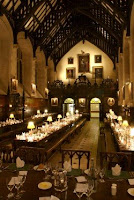
Having been founded in 1314, Exeter is the fourth oldest College at the University of Oxford. As one of the three "Turl Street Colleges," the other two being Jesus and Lincoln, Exeter is centrally located on the Turl Street, which links the High Street with the Broad Street. From what I hear, Exeter has a fierce rivalry with neighbor Jesus College as they hurl more than just insults across each others' medieval walls. Of course, Exeter has a reputation for being laid-back. We're known for possessing a quiet confidence, yet without the pretension, so it's unlikely that an Exeter student would ever instigate a fight. 

Exeter most often makes it into the Travel Guides, because of its chapel spire that was constructed by Sir George Gilbert Scott, a famous British architect, who based this design on the Sainte Chapelle in Paris. The chapel, perhaps the most well-known in Oxford, also boasts artistic designs by Sir Edward Burne-Jones, who attended Exeter in the 1850's with friend, and writer, William Morris. But besides its fair share of Nobel Prize winners, statesmen, and Rhodes scholars, Exeter is perhaps best know for having been the undergraduate College of J.R.R. Tolkien, expert on Anglo-Saxon history, and writer of the "Lord of the Rings" trilogy. More recently, contemporary writer Philip Pullman, another fellow Exonian, returned to Oxford to film the movie, "The Golden Compass," which was based on his popular "Dark Materials" book series. I'm proud of my College, and hope to add to its distinguished history! But even more important, I can't wait to invite my family and friends who visit me to sit at the "High-Table" for a candle-lit dinner in our medieval hall pictured above! 

Admission tip #3: I've read at least one other blog of an MBA student who created an intricate Excel spreadsheet featuring certain characteristics of each College to help him determine which one he should choose. I must confess that before reading his blog, I too, created my own spreadsheet, which included such variables as: date College founded, academic ranking (according to the Norrington Table), number of MBA students in attendance, selectivity of college, and notable alumni. 

Once I narrowed down my list from 38 Colleges to my "top 8," I researched who the MCR student President was on Wikipedia and emailed them my interest in their respective College. I asked them to refer me to current MBA students so that I could get the inside-scoop. The responsiveness and comments of these MBAs also influenced my decision. I should note that normally this would be a moot point because you "pre-select" your top 2 College choices in your initial application. However, after acceptance, all students are allowed to change their choice although this is generally frowned upon. I had no choice, because my first College choice (New College) had already been filled during application Round 1. 

Anyway, I actually went a step further by searching the Oxford homepage for the Management professor at the my next College choice (Balliol). I found a hyper-link to his working papers, and I proceeded to read the abstracts for all 100+ of his articles (etc.). I then pro-actively emailed that professor indicating to him that I had applied to his College, and that I thought I would be a good fit based on his research and my background. I proceeded to briefly state the true relevant areas of overlap. The professor was very kind, but informed me of the limited number of students that that College accepts. It's true. The b-school told me that this College accepts only 1-3 students, and that they had already accepted 3 and rejected 5 others. Donald Trump is fond of saying that it never hurts to ask, because the worst someone can say is no. So, although my efforts were in vain, I can rest easy knowing that I did everything within my power to try and influence events. After Balliol rejected me, of course, I had my application forwarded on to Exeter where I was happily accepted.

Wednesday, June 10, 2009

pre-mba: college selection process

I've written elsewhere on this blog about how "Oxbridge" differs from many American colleges (or any college for that matter) in that Oxbridge uses a system of Colleges whose role is to matriculate, care for, and graduate their students. Undergraduate students apply directly to their College of choice, rather than to the University itself. It differs for graduate students, who first apply to the appropriate program department (i.e. b-school). Then, once accepted, the student must produce a "financial guarantee" (unlike American colleges) that proves they can finance the tuition and room & board (I needed to prove 48,000 pounds total). MBA students must also pay a 15% down-payment credited toward tuition within 30-days of the acceptance offer to secure their seat in the program. Only then, does a student's "dossier" (aka: application) get forwarded on to their first (and if need be, second...and so on) choice of Colleges. All accepted grad students are guaranteed College admission, the twist is...where?

By latest tally, students can choose to have their application sent to any of the 38 Colleges and 6 Private Halls. The 5 oldest Oxford Colleges are: University, Balliol, Merton, Exeter, and Queens. However, GreenTempleton is the de-facto b-school College. Plus, Worcester is most closely located to the b-school. Also, I hear that St. Hughes has the best food, although it's located in northern Oxford (Jericho). Further, if you're a rower (1 out of 3 students row at some level at Oxford), then Oriel might be the choice for you (just watch "Oxford Blues" with Rob Lowe). You can see that students pick Colleges for many different reasons & they are all wonderful choices!

It might help prospective Oxford MBA students to know how my own time-line unfolded. I applied to the Oxford MBA program for the Round 2 deadline on 01/16/2009 (there are 4 Rounds). I found out that I was accepted on 03/27/2009, which was the R2 admission decision deadline (early notification is only given if you are under time-pressure to choose between a competing MBA offer). Things moved fast. I paid my deposit 15-days later, because I wanted to get a jump-start on my classmates for College selection. 

I had my application sent to Balliol first, which happens to be the most popular College at Oxford (as measured by the total volume of applications received). I heard that in the past Balliol had accepted just 1 MBA student who happened to be a Rhodes Scholar from Harvard that had majored in micro-cell biology. Still...it didn't hurt to try. Balliol received my application on 04/27/2009, the same day my "financial guarantee" was confirmed by Oxford (I was waiting on my student loan approval. It took me just 5-business days from application to approval through SallieMae, but don't wait!) Unfortunately, Balliol rejected me 2-weeks later. 

Without hesitation I called, and had my application forwarded on to Exeter College, which is centrally located on Turl Street. Exeter also provides recently renovated housing for its grad students for low cost at Exeter House on Iffley Road. Home to J.R.R. Tolkien during his undergrad years, Exeter College also served as the setting for the fictional "Jordan College" in the movie, "The Golden Compass," based on the book(s) by former Exeter student, Philip Pullman. If you can't already tell, I was accepted by Exeter on 06/02/2009. They took just 8-days to make their decision. In another post I will write more about Exeter College and post some photos. in the meantime, enjoy the "Admission tips" below:

Admission tip #1: no matter what they say, you improve your chances for acceptance (and getting your choice College) by applying in Round 1 or 2. Later Rounds do get more difficult as space fills up, and students start looking less unique. By R4 you better have a 700+ GMAT, a 3.5+ GPA from an Ivy-league college, have worked for an investment bank or management consulting firm, and have spent 2-years as a Peace-Corp volunteer building schools in Africa.

Admission tip #2: it is critical that you email (and call to follow-up on your email) the Oxford administrator in charge of College placement, otherwise, you will invariably get lost in the crowd. Although they will get to you eventually, you can't afford to miss even a week as spaces fill quickly. Christ Church and New College filled-up before R2 students were admitted for the 2009-2010 academic year. And, similarly, the following colleges were full before R3 students were admitted: Balliol, Brasenose, Exeter, Jesus, Lincoln, Magdalen, Merton,  St. John's, and Worcester. 

I think that the most prestigious remaining choices for R3 and R4 students are (in alphabetical order): Corpus Christi, Oriel, Pembroke, Queens, and Trinity. I think that Oriel is waiting to admit an Olympic rower. And it appears Trinity only accepts SBS scholarship winners. Meanwhile Queens offers no housing, which has undoubtedly deterred some students from applying. Some of the other Colleges fill quickly because they take few MBAs (1 each for Balliol & Magdalen) while others possess the holy trinity of prestige, academic rankings, and central location (8 each for Merton & Brasenose). In fact, Brasenose just opened very desirable grad housing directly across from the b-school for 2009! But, perhaps, Christ Church stands alone as the penultimate of all the Oxford Colleges having left indelible images in both literature (Alice in Wonderland, Brideshead Revisted) and in the movies (Harry Potter) - plus, it's filthy rich! (their £228,744,460 endowment as of 2006 is the 2nd largest endowment of any Oxford College other than St. John's)