Showing posts with label saïd business school. Show all posts

Saturday, March 20, 2010

hilary [week 8]: hector sants, ceo of fsa

Before choosing Oxford for my MBA, I had visited several other business schools. I was surprised to learn that in just about every instance, other business schools were geographically and culturally separate from the larger university. One thing that appealed to me about Oxford was the fact that the Saïd Business School is an integral part of the University of Oxford.

Many of the people whose names splash the headlines of the Financial Times come and speak at Oxford. In this way the business school benefits from Oxford’s 800-year history of educating leaders. Last Friday was no exception. Fresh from his morning interview with the BBC Today show, Hector Sants returned to his alma mater to deliver the Annual Lubbock Lecture in Management Studies to a packed theatre at the Saïd Business School, entitled “UK Financial Regulation: After the Crisis.”

Having served the past three years as CEO of the Financial Services Authority, Mr. Sants had already handed in his resignation in February, but with 6-months left to go in his term, he had a new announcement that he wanted to make at Oxford. As President of the Oxford Finance Club, I attended the event, and I was also invited to the boardroom afterwards to have dinner.

During the dinner, we followed Chatham House Rules allowing us to speak freely, but on the condition that opinions remained anonymous. We all shared a good laugh when I pointed out the fact that Mr. Sants and I would both be looking for jobs this summer. It just so happens that the FSA is hiring. I was surprised to learn that regulators get more exposure to global capital markets than investment bankers. I also suspect that regulators will be in high demand over the next few years as the financial services industry waits nervously to see what new rules will be meted out.

Mr. Sants’ tenure as CEO of the FSA began inauspiciously in July 2007. He had the misfortune of being appointed just weeks after two hedgefunds at Bear Stearns unexpectedly collapsed. This was followed by the American Home Mortgage bankruptcy in August. During these early days of the recession few had ever heard of collateralized mortgage obligations, or credit default swaps.

It was only a matter of time before the spill-over effect rippled across the Atlantic. The first to fall in the United Kingdom was Northern Rock in February 2008. Next, the British government nationalized part of Lloyds Bank and RBS. The FSA quickly found itself thrust into the limelight.

When the dust finally settled, the FSA received mixed reviews on its handling of the economic crisis. Many viewed the FSA as having too light of a touch for an industry that had witnessed regulatory concerns dating back to 1995 when Barings Bank collapsed. It appears that lax oversight may have once again contributed to a repeat of corporate excess.

To combat these criticisms, Mr. Sants emphasized during his speech that the FSA needs to be more proactive, including intervening earlier. Mr. Sants formally announced tougher consumer protection rules governing the sale of financial products to the public. He declared, “We will now seek to proactively intervene earlier in the product chain to anticipate consumer detriment and choke it off before it occurs.” This new “outcomes-based” approach to regulation replaces the previous “principles-based” regime. The FSA will continue to follow a broad set of principles, but the big difference will be much stricter supervision.

The new FSA approach to regulation ratchets up the dial on government heavy-handedness – perhaps too far. For example, reform on an institutional level will at the very minimum entail annual stress tests for banks. His speech also alluded to a possible “insurance tax” on financial institutions to offset systemic risk. Mr. Sants summarized his position as follows, “Higher capital and liquidity will reduce the probability of failure.” Mortgage companies will also be policed by “mystery shoppers” who will be monitoring lending standards. Many wonder whether the FSA is going too far, or not far enough?

Despite these recent overtures, however, the FSA must still contend with the very real possibility that a Tory victory in the upcoming months may entirely uproot the institution that Mr. Sants has worked so hard to reform. Time will tell whether the money and political will exist for the FSA to succeed.

*At the request of the Saïd Business School Press Office, this blog was posted on the website "BusinessBecause" in an article entitled, Hector Sants Makes FSA Announcement at Oxford University.*

Monday, June 15, 2009

pre-mba: preparing for oxford

One of the most quintessential Oxford experiences is to row for your College. The ultimate, of course, is to be good enough to compete against Cambridge in the annual "Boat Race" for the chance to win a "Blue." But to put things into perspective, this year's boat (2009), which beat Cambridge, had 8 rowers, all of which were affiliated with the Saïd Business School at Oxford, and two of which actually rowed in the last Olympics! Regardless of age or ability, roughly 1 out of 3 Oxford students row at some level for their College. To succeed, even the amateur rowers wake-up for practice by 6am, and regularly run 4 miles to prepare themselves to compete.

I more modestly aspire to condition myself to pull my own weight in the boat. Although I have always played sports, even at the collegiate level, my greatest fear are the curses and mumblings I'll hear from my teammates as they see me try and squeeze into our tiny boat. Therefore, I decided last week to take fate into my own hands, and join a gym. Every day this week I've been jogging 3-miles on the treadmill, and then hitting the weights for another 30-minutes. Plus, I've been working in some tennis. For just $10 per/month I joined "Planet Fitness" to begin my quest to lose 15-20 pounds within 3-months before shipping off to England.

During my admissions interview at Oxford in February, I attended an "Open House" where the MBA administrators told us all about what to expect during out MBA course. At one point, they neatly presented a bar chart on the wall that clearly laid-out our day-to-day schedule: 3 hours of outside study, 3 hours of job search, 1 hour of sports, and 1 hour of debauchery. The rest of the day was presumably spent eating, sleeping, traveling to and fro, and actual class-room time. They recommended finding a balance between the very serious work at hand, and a chance to network with the larger university. According to their recommendation, though, it would be unwise to partake in more than 2 outside activities. So, after deciding on rowing, I had just one more arrow in my quiver before having the next year planned out exactly to the minute. 

In addition to rowing I thought I'd take up tennis. I've been playing tennis for 13 years now, and although I'm rusty, it's perhaps the best sport I have a chance to "really" compete in. During my undergraduate years I played for one year for my college team. Currently, I play in a Mens 3.5-4.0 USTA League in New York, but I've got a lot to work on! I would recommend anyone interested in sports, even at the recreational level, to find the appropriate contact at the Oxford University Sports Club page. 

In conclusion, no one disagrees that attending the Oxford MBA will be a hugely transformational experience, both professionally and personally. Part of that experience is to immerse yourself in the sporting tradition of the University, particularly rowing. But just as you would start preparing for your classes by brushing up on your math, it is also a wise idea to prepare yourself physically for what is sure to be an immensely mentally and physically grueling year!

Thursday, June 11, 2009

pre-mba: exeter college

On 06/02/2009 I learned that Exeter College at Oxford accepted my application! It took them about 8-days to make their decision, however, I didn't find out until a week later, and it would've been longer (no doubt) if I had not contacted the b-school to inquire! As a newly admitted grad student I become a member of the Exeter MCR (Middle-Common Room), as opposed to the JCR (Junior Common Room), which is reserved for undergraduates. Technically, MCR students may also benefit from all the JCR activities, as well, so it's a no-lose situation for MBAs!

One good thing about Exeter is that it offers grad student housing at the newly renovated Exeter House on  Iffley Road. Although it's located a little further from the b-school then I would like, it gives me a chance to get some exercise by riding my bike. Plus, I'll get to live with 50+ other grad students studying all different subjects, which will allow me to make life-long friends independent from the b-school, which is good. It also saves me the additional airline flight (and frustration) in finding my own apartment, and flatmates to share it with. Plus, at about $500USD per/month for my own room, it's a steal!
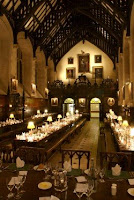
Having been founded in 1314, Exeter is the fourth oldest College at the University of Oxford. As one of the three "Turl Street Colleges," the other two being Jesus and Lincoln, Exeter is centrally located on the Turl Street, which links the High Street with the Broad Street. From what I hear, Exeter has a fierce rivalry with neighbor Jesus College as they hurl more than just insults across each others' medieval walls. Of course, Exeter has a reputation for being laid-back. We're known for possessing a quiet confidence, yet without the pretension, so it's unlikely that an Exeter student would ever instigate a fight. 

Exeter most often makes it into the Travel Guides, because of its chapel spire that was constructed by Sir George Gilbert Scott, a famous British architect, who based this design on the Sainte Chapelle in Paris. The chapel, perhaps the most well-known in Oxford, also boasts artistic designs by Sir Edward Burne-Jones, who attended Exeter in the 1850's with friend, and writer, William Morris. But besides its fair share of Nobel Prize winners, statesmen, and Rhodes scholars, Exeter is perhaps best know for having been the undergraduate College of J.R.R. Tolkien, expert on Anglo-Saxon history, and writer of the "Lord of the Rings" trilogy. More recently, contemporary writer Philip Pullman, another fellow Exonian, returned to Oxford to film the movie, "The Golden Compass," which was based on his popular "Dark Materials" book series. I'm proud of my College, and hope to add to its distinguished history! But even more important, I can't wait to invite my family and friends who visit me to sit at the "High-Table" for a candle-lit dinner in our medieval hall pictured above! 

Admission tip #3: I've read at least one other blog of an MBA student who created an intricate Excel spreadsheet featuring certain characteristics of each College to help him determine which one he should choose. I must confess that before reading his blog, I too, created my own spreadsheet, which included such variables as: date College founded, academic ranking (according to the Norrington Table), number of MBA students in attendance, selectivity of college, and notable alumni. 

Once I narrowed down my list from 38 Colleges to my "top 8," I researched who the MCR student President was on Wikipedia and emailed them my interest in their respective College. I asked them to refer me to current MBA students so that I could get the inside-scoop. The responsiveness and comments of these MBAs also influenced my decision. I should note that normally this would be a moot point because you "pre-select" your top 2 College choices in your initial application. However, after acceptance, all students are allowed to change their choice although this is generally frowned upon. I had no choice, because my first College choice (New College) had already been filled during application Round 1. 

Anyway, I actually went a step further by searching the Oxford homepage for the Management professor at the my next College choice (Balliol). I found a hyper-link to his working papers, and I proceeded to read the abstracts for all 100+ of his articles (etc.). I then pro-actively emailed that professor indicating to him that I had applied to his College, and that I thought I would be a good fit based on his research and my background. I proceeded to briefly state the true relevant areas of overlap. The professor was very kind, but informed me of the limited number of students that that College accepts. It's true. The b-school told me that this College accepts only 1-3 students, and that they had already accepted 3 and rejected 5 others. Donald Trump is fond of saying that it never hurts to ask, because the worst someone can say is no. So, although my efforts were in vain, I can rest easy knowing that I did everything within my power to try and influence events. After Balliol rejected me, of course, I had my application forwarded on to Exeter where I was happily accepted.

Wednesday, May 13, 2009

"adam smith was incomplete!" - john nash

Many people unfamiliar with Oxford are surprised to learn that the University is not actually a physical location, but is rather comprised of 39 colleges and 5 halls that are semi-autonomous.

Finding the University is like finding the key to the "batter's box" - it just doesn't exist. This means that Oxford students, like myself, not only belong to the University, but we also matriculate and graduate from one of these many Colleges.

The collegiate system represents the defining characteristic of the "Oxbridge" (Oxford and Cambridge) experience. Ever since the first Colleges originated during the 13th century (Balliol, Merton, and University) to protect students from suspicious townsfolk, Colleges continue to look after the welfare of their students by providing a central location for dining, housing, praying, and teaching. All four functions are conveniently located among the four walls that comprise the quintessential Oxford "quad."

Once accepted into the MBA program, the businesss school forwards the student's "dossier" (application) to their first College choice. Only 1 College can review your application at a time, and the process takes 3-4 weeks. Rejected applications are then forwarded onto the student's 2nd choice (etc.) until a match is found. All admitted students are guaranteed College membership.

The pecking order is in large order determined by academic performance, as calculated annually in the popular "Norrington Table": http://en.wikipedia.org/wiki/Norrington_Table. However, the practically minded take into account other qualatative factors such as quality of life (food and housing), as well as the history and identity of the College.

The "Oxford College Pros and Cons" article at the http://www.thestudentroom.co.uk/ offers good anecdotal advice. For example, Balliol College is considered politically liberal, while neighbor Trinity College is known to lean more conservatively. Oriel College developed a reputation for rowing, while Merton College is popular with the Japanese because Crown Prince Naruhito of Japan studied there. As a Round 2 admit, I'm considering Balliol, Brasenose, Exeter, and Queens.

I loved studying "game theory" in college (A+ grade!). The whole College selection process reminds me of John Nash's equilibrium (cue "A Beautiful Mind") where, in this case, you must calculate the expected "pay-off" of getting accepted into a particular College (your 1st choice, 2nd choice, etc.), as well as the probability of getting accepted into your top choices...

...meanwhile, the College is busy at work making its own calculations and decisions independent of you. On top of all of that, the student has imperfect information regarding accurately calculating both the pay-off (unfamiliarity with the different Colleges) and the likelihood of acceptance (lack of transparency). Bring on those decision tree matrices...B-SCHOOL HERE I COME!

Wednesday, April 29, 2009

"24" (and I don't mean the tv series)

With about 4 1/2 months to go before I leave for Oxford, I'm doing everything I can to ensure that the brief year I'm there for is as productive as possible. I want to leave as little up to chance as possible. I've already begun my post-MBA job search, including pre-filling my job applications online to save me time later in the year when I'm buried nose-deep into my macroeconomics textbook trying to figure out the relevance of a logarithmic function when constructing a marginal utility curve.

When not solving quadratic equations, I always thought it made good business to model your behavior after others that you admire, or aspire to be. For example, after businesss school, I thought about returning to Citi to work as an investment banker at Citi Capital Strategies. Since all of their "I-bankers" were previous financial advisors with their Series 24 Principal license, I decided to muster up some courage last week, and ask my boss to sponsor me for the Series 24 exam, which he did!

While not as glamourous as a guest role on the TV series "24" with Jack Bauer, within the world of Wall Street, it is impressive. I have to climb-up 3-wrungs on the corporate ladder before I find another person who holds the Series 24, so it's a big honor, even though right now there are few jobs to be had.

So, now I'm busy studying. I plan to take the 3 1/2 hour exam in 4-weeks so that I can clear the way for studying for the CFP exam in mid-July. Thankfully, Lisa agreed to look the other way when I posted up my white board near our computer desk to help organize myself. I'm going to need to make the most out of my 24-hours over the next 4 1/2 months!

Monday, April 27, 2009

tribute to my fiancée and family

On March 27th, earlier this year, I learned that after my second application attempt, I was finally accepted into the MBA program at the Saïd Business School at Oxford University. It was truly a dream come true. Nearly 10 years earlier in 2000, I had studied abroad at Oxford while an undergraduate student at the State University of New York. That was when I first heard of the business school as they had just started breaking ground on their new state-of-the-art building. I immediately knew then what it would mean to me to return to England one day, and earn my degree from "the city of dreaming spires."

However, a lot happened during those intervening years. For one, I finally finished my undergraduate degree! I also transitioned careers from managing my brother's beucolic Hamptons cafe to investing other peoples' money as a financial advisor for some of the top Wall Street investment banks. But most importantly, I finally woke up and smelled the coffee, and realized that the love of my life was right in front of me all along. After 10 years of due diligence I am happy to say that my now fiancée did not hold it against me, and she agreed to marry me.

Of course, this made the prospect of leaving to do my MBA nearly 3,500 miles away in blighty ole' England problematic. Thankfully, I have a very understanding fiancée, and as long as I bring home the bacon I will have a very happy household to return to. That is why it is my great pleasure to thank my fiancée and family for all of their understanding, and continued support, as I take one great leap into the unknown with the hope of making a difference, and improving our family's fortunes. Wish me luck - I look forward to sharing my journey with you!